
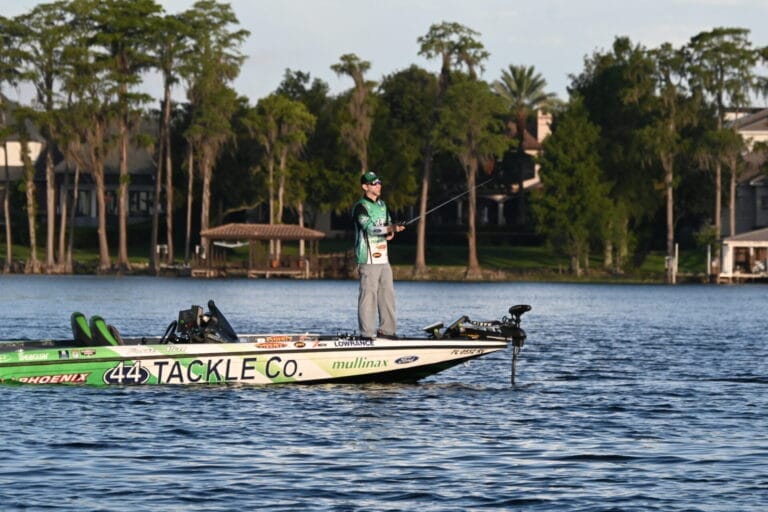
There is an abundance of bass fishing resources devoted to helping people with lure selection, techniques, and patterns. All of which are designed to improve our fishing skills and put more and larger bass in our livewells. However, there is one skill which is sorely overlooked in our fishing community and can cost us bass and tournament winnings. I cannot emphasize enough the importance of boat positioning.
What is Boat Positioning?
Boat positioning is the skill of maneuvering, maintaining, and navigating your boat around fishing areas. The typical equipment used for boat positioning is primarily our trolling motors and shallow water anchoring systems, such as Power Poles. There are a number of other devices that we can install on our boats and equipment. The new Power Brakes or Sidekick can also be installed on Power Poles to allow for better control in windy conditions. Also, most trolling motors now come with a “spotlock” feature that allows for automatic “free-anchoring” offshore based upon your GPS position. This helps keep the boat in place at the selected coordinates.
Why is Boat Positioning Important?
Proper boat positioning is VERY important for a number of reasons. One reason is that it puts us in a position to make an accurate cast to the desired target. Too close of a boat positioning can scare off the bass due to trolling motor noise, transducer sound, or boat noise; while too far off of a position can require a longer, less accurate cast along with a more violent splash of our lure. Placing our boat in a position in which we can make an accurate cast in the direction that we want will lead to more bites. Targeting grass lines and points, ledges and drop-offs, and casting down lines of boat docks are all established bass patterns. However, even the right lure and pattern will fail if the boat is not in the right position to cast to that target.
Boat Positioning Scenarios
Vegetation
All across America there are an abundance of vegetation in our lakes. This may range from grass, hydrilla, milfoil, Lilypad’s, and the list goes on. A common pattern is fishing the “edges” or lines of the vegetation. Good boat positioning is essential for catching fish down a grass line. If your position is too far away, you may not be able to cast down the grass line. However, if you are going to be making casts down a grass line, then you need to have your boat positioned closer to the target. If you’re too far away, you may be hitting small areas of the grass line, missing much of the fishable grass.
Rock Bank Drop-off or Bluffs
Good boat positioning is very important when fishing bluff walls or drop-offs. So much so that it can determine whether you win a tournament or don’t get a bite that day. It’s important to match your boat position to your bait as it could affect the depth and action of the lure. For example, if you’re throwing a crankbait that dives 15 ft, you will want to know how far away from the bank to be in order to allow your bait to get down to 15ft. Finding the angle of your cast at the bank, and the distance from the bank is important for reaching the depth you want your lure to run. Another scenario is if you are fishing a bank that drops into 25 ft of water, but the fish are stationed in 10 ft of water. You might want to position your boat at a distance away from the bank that allows you to keep your lure in the 10 ft of water the longest. That could involve moving the boat closer to the wall and casting down the bank as opposed to towards the bank. To summarize, it’s very important to match your bait depth to the distance to the bank and in relation to the depth the fish are holding.
Windy Conditions
A lot of fishermen avoid wind, but I want us all to say this together, “wind is our friend, wind is our friend, wind is our friend.” Yes, wind is our friend in many situations but the key to fishing the wind is boat positioning. Obviously, it depends on the amount of wind and size of the body of water we are fishing. However, many fishermen think fishing with the wind is the way to go. I for one, disagree. I like fishing against the wind. By fishing against the wind, I can better manage the speed of my boat and can slow down and thoroughly cover the water that I’m trying to fish. By fishing with the wind, you have less control over your boat and will move past fishing spots faster than you want. It also makes working the bait more difficult as the boat is moving faster towards your lure, meaning you lose sensitivity, control of the lure, and ability to feel bites. By fishing against the wind, you can pin point fishing spots, cast up wind and bring the lure down wind which does a better job mimicking the baitfish coming with the wind, and allow for you to slow down your presentation and hit more spots. There are devices, like “wind socks” or Power Brakes that would make it easier to maneuver with the wind, but these too have their limits in maneuvering the boat.
Water Current
Much like the wind, you want to pay attention to how your boat is positioned in current. Current will modify your lures action and depth. Many fishermen go with the current to save trolling motor battery; therefore, when fishing current it is important to make sure you have plenty of battery power and that the batteries are well charged. Fishing against the current allows for slower presentations, more thoroughly fishing an area, and more realistic lure actions of the baitfish. Furthermore, fishing against the current sets fishermen up better for throwing to and fishing “eddies.” Eddies are prime spots for bass to sit and wait for bait to pass by.
Final Thoughts
As discussed, boat positioning is an incredibly important factor that most fishermen tend to overlook. Next time you’re on the water, pay attention to those little details. Be mindful about your boat position in relation to structure and the wind. Notice how it affects your bait and depth your lure is running. Also, pay attention if your lure is mimicking the same direction that the wind, current, and baitfish are moving. At the end of the fishing day, analyze your boat positioning for that day. Did you find yourself fishing too close to the cover? Making too much noise? Being too far away from structure and not covering what you wanted? Should you have been casting down a bank versus throwing to the bank? Do an overall assessment of how you were able to maneuver the boat and how it impacted your catch for that day. What can you do better for next time? I can tell you that utilizing my Power Pole anchoring system along with the spotlock feature on my trolling motor has contributed to me catching more fish and definitely winning more money. I guarantee that if you start paying more attention to your boat maneuvering skills and boat positioning it will also put more fish in your livewell.